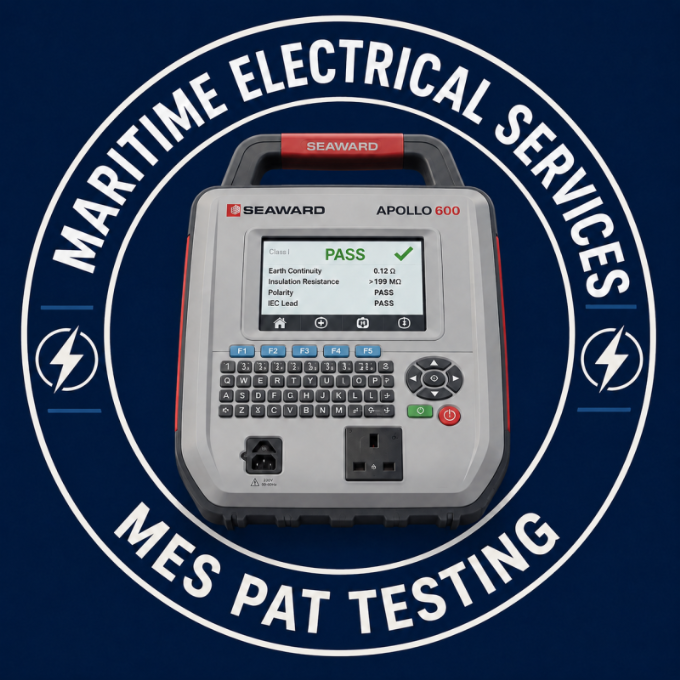
PAT testing — portable appliance testing — is the process of inspecting and electrically testing portable equipment to check it is safe to use. We explain what it involves, who needs it, and what the law actually requires.
What is PAT testing?
PAT testing — portable appliance testing — is the process of inspecting and electrically testing portable electrical equipment to verify that it is safe to use. The term covers both a visual inspection of the appliance, its cable, and plug, and a series of electrical tests carried out using a specialist PAT tester instrument.
The purpose is straightforward: to identify electrical faults before they cause injury, fire, or damage. A faulty appliance may look perfectly normal on the outside while carrying a dangerous fault internally. PAT testing provides a structured, documented way to catch those faults.
The "portable" in portable appliance testing refers to any equipment that is connected to the mains supply via a plug and socket. It does not mean the equipment has to be lightweight or easily moved — a large floor-standing photocopier is a portable appliance in this context, as is a desktop computer, a kettle, or a power drill.
What does PAT testing involve?
A full PAT test has two stages: a visual inspection and an electrical test.
Visual inspection
The engineer inspects the appliance, its cable, and its plug for visible signs of damage or deterioration. This includes:
- Frayed, cut, or damaged cables
- Cracked, broken, or discoloured plugs
- Signs of overheating — scorch marks, melted plastic, or discolouration around the plug or socket
- Damaged or missing cable grips where the cable enters the plug or appliance
- Incorrect fuse ratings
- Evidence of unauthorised modifications or repairs
- Damage to the appliance casing
A significant proportion of electrical faults are detectable by visual inspection alone. The IET Code of Practice notes that for low-risk equipment in stable environments, a thorough visual check may be sufficient without a formal electrical test.
Electrical tests
Where a formal electrical test is required, the engineer connects the appliance to a calibrated PAT tester and runs a series of automated tests. The specific tests depend on the class of the appliance:
Earth continuity test. For Class I appliances (earthed equipment), this test confirms that the earth connection is intact and provides a low-resistance path to earth. A failed earth continuity test means the appliance is not safely earthed and could deliver a fatal shock if a fault develops.
Insulation resistance test. This test applies a high DC voltage between the live conductors and the earth or casing, and measures the resistance of the insulation. Good insulation should present very high resistance — typically above 1 MΩ. Low insulation resistance indicates deterioration or damage that could allow current to leak to the casing.
Substitute leakage test. Used where a full insulation resistance test is not appropriate — for example, on equipment containing sensitive electronics. It measures the leakage current under normal operating conditions.
Lead polarity test. Checks that the live, neutral, and earth conductors in the cable are connected to the correct terminals in the plug.
Modern PAT testers such as the Seaward Apollo 600+ run these tests automatically in sequence and record a pass or fail result for each.
What happens after the test?
Each appliance receives a pass or fail label showing the test date and, where applicable, the next recommended test date. The engineer records every appliance in a test register — typically a spreadsheet or dedicated PAT testing software — showing the appliance description, asset number, location, test date, individual test results, and overall pass or fail.
On completion, a test certificate is issued covering the full site. This certificate is your documentary evidence of compliance for insurance purposes, HSE inspections, and — in regulated sectors — CQC audits or local authority checks.
Failed appliances are labelled accordingly and taken out of service. Depending on the nature of the fault, the engineer may be able to carry out a minor repair on site — replacing a plug or fuse, for example — and retest immediately. More significant faults require the appliance to be withdrawn for repair or disposal.
Who needs PAT testing?
Any employer, landlord, or organisation that provides electrical equipment for use by employees, tenants, or members of the public has a legal duty to ensure that equipment is maintained in a safe condition. PAT testing is the most widely used method of discharging that duty for portable appliances.
In practice, this covers a very wide range of organisations:
Offices and commercial premises. Computers, monitors, printers, desk fans, phone chargers, kitchen appliances in staff areas — all are portable appliances that fall within scope.
Schools, colleges, and universities. IT suites, science laboratories, art rooms, catering facilities, and staff offices all contain significant quantities of portable equipment. The IET recommends annual testing for Class I equipment in educational settings. See our guide to what appliances need PAT testing in a school.
Care homes and NHS trusts. Healthcare settings have additional obligations under HTM 06-01, the NHS guidance on electrical safety. Annual testing of Class I equipment is standard practice, and records must be maintained for CQC inspection.
Retail and hospitality. Tills, display lighting, kitchen equipment, and back-of-house appliances all require regular inspection. High-use environments and equipment handled by multiple staff members warrant more frequent testing.
Landlords and letting agents. Landlords who provide electrical appliances as part of a furnished tenancy — white goods, televisions, lamps — have a duty of care to tenants. While there is no specific legislation requiring PAT testing for residential landlords, the Landlord and Tenant Act 1985 and the Electrical Safety Standards in the Private Rented Sector (England) Regulations 2020 both require electrical installations and equipment to be safe.
Construction sites. One of the highest-risk environments for portable appliances. The IET recommends testing extension leads every month and Class I equipment every three months on active construction sites.
Events and hospitality. Temporary installations, hired equipment, and high-turnover environments all carry elevated risk. Equipment used at events should be tested before each event or at regular intervals depending on frequency of use.
Is PAT testing a legal requirement?
This is one of the most common questions — and the answer requires some care.
There is no law that specifically requires PAT testing by name. The Health and Safety at Work Act 1974 places a general duty on employers to ensure the health and safety of employees and others affected by their work activities. The Electricity at Work Regulations 1989 require that electrical systems — including portable appliances — are maintained in a safe condition. Neither piece of legislation specifies how that maintenance must be carried out or how often.
PAT testing is not the only way to comply with these duties, but it is the most widely accepted and documented method. In the event of an incident involving a faulty appliance, an employer who cannot demonstrate a systematic programme of inspection and testing would find it very difficult to show they had met their duty of care.
For certain sectors, the obligation is more explicit. NHS trusts and healthcare providers are expected to follow HTM 06-01. Schools maintained by local authorities are subject to guidance from the Department for Education. Organisations subject to CQC inspection must be able to demonstrate electrical safety compliance.
The practical position for most businesses is this: PAT testing is not legally mandated by name, but failing to carry it out — or failing to keep records — leaves you exposed if something goes wrong.
What is the difference between Class I and Class II appliances?
Understanding appliance classes helps explain why different tests are applied to different equipment.
Class I appliances rely on both insulation and an earth connection for protection against electric shock. If the insulation fails, the earth connection provides a safe path for fault current and should cause the circuit breaker or fuse to operate. Examples include most metal-bodied appliances: kettles, toasters, floor-standing equipment, and many power tools. Class I appliances require an earth continuity test as part of PAT testing.
Class II appliances (also called double-insulated) have reinforced or double insulation and do not rely on an earth connection. They are marked with the double-insulation symbol — a square within a square. Examples include most modern power tools, many IT products, and small domestic appliances. Class II appliances do not require an earth continuity test but should still be visually inspected and insulation-tested.
Class III appliances operate at safety extra-low voltage (SELV) — typically below 50V AC. They present minimal shock risk and generally require only a visual inspection.
How often does PAT testing need to be done?
There is no fixed legal interval. The IET Code of Practice recommends a risk-based approach, with suggested intervals that vary by equipment type and environment:
- Construction sites: extension leads monthly; Class I equipment every 3 months
- Industrial and manufacturing: Class I equipment every 6–12 months
- Schools: Class I equipment annually; IT equipment every 4 years
- Offices: IT equipment every 4–5 years; Class I equipment every 1–2 years
- Hotels and hospitality: Class I equipment annually; IT equipment every 2 years
- Care homes and NHS: Class I equipment annually in line with HTM 06-01
These are starting points, not fixed rules. Your own test history should inform the intervals you adopt — if equipment consistently passes without fault, it may be reasonable to extend the interval. If faults are regularly found, the interval should be shortened. Any decision should be documented as part of your risk assessment.
For a more detailed breakdown of testing frequencies by sector, see our guide on how often PAT testing should be carried out.
What qualifications does a PAT tester need?
There is no legal requirement for a PAT tester to hold a specific qualification. The Electricity at Work Regulations 1989 require that testing is carried out by a "competent person" — someone with the knowledge, skills, and experience to carry out the work safely and correctly.
In practice, reputable PAT testing contractors employ engineers who are City & Guilds qualified and trained in the use of calibrated test equipment. At Maritime Electrical Services, all engineers hold City & Guilds qualifications and carry out testing in accordance with the IET Code of Practice for In-Service Inspection and Testing of Electrical Equipment (5th edition).
Using a qualified contractor also ensures that your test records and certificates will withstand scrutiny from insurers, the HSE, or sector regulators.
What is included in a PAT testing certificate?
A PAT testing certificate — more accurately described as a test report — documents the outcome of the testing programme for a site. It typically includes:
- The name and address of the site
- The date of testing
- The name and qualifications of the engineer
- A full appliance register listing every item tested, with individual test results and pass/fail status
- A summary of any failed appliances and the action taken
- The engineer's signature
The certificate is issued on completion of the visit. At Maritime Electrical Services, full test reports and certification are issued on the day of testing.
How much does PAT testing cost?
PAT testing is priced per appliance. At Maritime Electrical Services, pricing starts from 89p per appliance for larger sites. Sites with fewer than 150 appliances carry a £70 service charge to cover travel and set-up; sites with 151 or more appliances pay the per-appliance rate only with no additional call-out fee. Volume rates of 89p per appliance apply for estates over 10,000 appliances.
For a detailed breakdown, see our PAT testing pricing page.
How do I arrange PAT testing for my business?
Maritime Electrical Services provides commercial PAT testing across Kent, London, Essex, Surrey, West Sussex, East Sussex, Hertfordshire, and Cambridgeshire.
To arrange a visit or request a quote, contact us. We will confirm the number of appliances, agree a convenient date, and provide written confirmation of the price before any work begins. Full test reports and certification are issued on completion of the visit.
Explore Topics
Written by
Maritime Electrical Services
Content creator and writer sharing insights and stories.